


산업 일반
Youth Financial Literacy is No Longer an Option…Financial Education Must Be Strengthened

◆이코노미스트가 글로벌 차세대 경제 리더, 청소년 기자단 영 저널리스트와 함께합니다. 영 저널리스트 기자단은 프리미엄 경제지 이코노미스트, 논술 전문 기관 Ni 에듀케이션과 함께 주요 시사 이슈를 팔로우업하고 직접 기획, 취재, 기사 작성 활동을 하며 사회적 문제를 고심하고 해결 방안을 제시하는 과정을 경험하게 됩니다. 이번 기사는 영 저널리스트 기자단이 현 사회현상에 대해 학생들 시선에서 ‘왜’라는 질문을 갖고 직접 취재해 작성한 기획기사입니다. 영 저널리스트 기자단의 기획기사는 영문과 국문, 두 형태로 게재합니다.
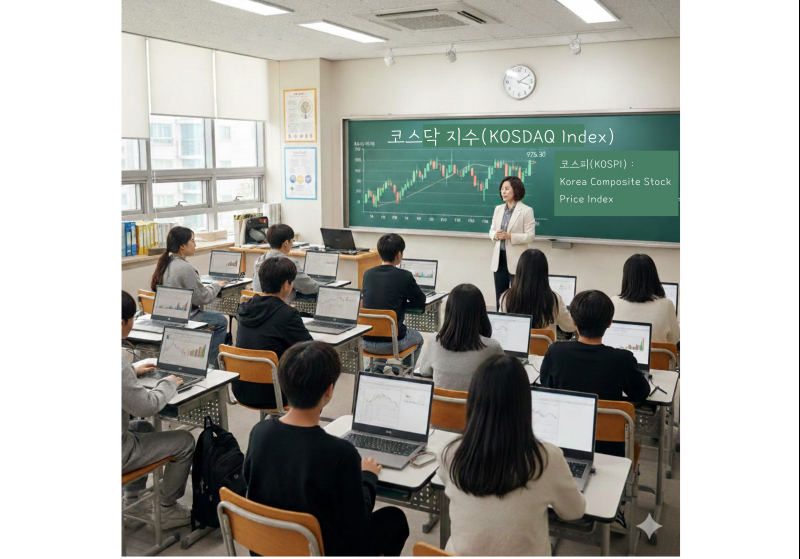
Weak Understanding of Economic and Financial Concepts amongst Korean Adolescents
According to recently released statistics, the level of economic and financial understanding amongst Korean adolescents and young adults is relatively weak. A 2024 survey on economic literacy among elementary, middle, and high school students conducted by the Ministry of Economy and Finance showed that scores at all levels declined compared to 2022, with sixth grade elementary students scoring 61.5 points, third year middle school students scoring 51.9 points, and second year high school students scoring 51.7 points. In particular, the scores of middle and high school students fell significantly below 60 points.
Furthermore, the 2024 National Financial Literacy Survey conducted by the Financial Supervisory Service and the Bank of Korea found that young adults who had just passed adolescence scored 62.6 points in financial literacy, which is lower than the overall adult average of 65.7 points. They were classified as a financially vulnerable group alongside people in their 70s. Altogether, these show the urgent need to improve economic literacy amongst adolescents and students.
Youth Financial Education Should Take Place Within Public Education
Looking at examples from overseas, the United Kingdom provides financial education as part of the national curriculum starting at age 11, while in the United States, as of 2025, 36 states require high school students to complete a financial literacy course as a graduation requirement. Conversely, in Korea, financial education is not offered as a standalone subject in elementary or middle schools. Instead, opportunities are provided through the middle-school free-semester system or as elective courses of high school. Although government agencies and commercial financial institutions support temporary education programs and campaigns for students, many argue that establishing financial education as a structured and regular subject within schools would be more effective. As a result of these calls, as of 2026 all 17 provincial and metropolitan offices of education have enacted ordinances to promote economic education, and hence established an institutional foundation at the regional level for advancing financial consumer education.
Here, Dr. Sun-young Cho, head of the School Economic Education Team at the Korea Development Institute (KDI), noted that “the growing interest in financial education at the school level and the expanding engagement of teachers can be seen as a positive change.” She added that “school-based financial education is a primary stage of establishing an institutional framework, and the key task going forward is to fill that framework with substantive and systematic content.” She also emphasized that “through continuous education across elementary, middle, and high-school levels, it is important to cultivate proper financial values and attitudes, and to provide financial consumer education grounded in students’ real-life experiences so that young people can make rational financial decisions based on reliable information in a digital setting.”
Financial Literacy Education for Adolescents as an Investment for the Future and a Social Responsibility
For adolescents of modern society, financial literacy is not an option, but a requirement. In the future, they will need to make economic and financial decisions at important moments in life, such as paying university tuition, preparing funds for independence to buy a home, and planning for retirement. Adolescence is a vital period during which values and habits related to money are formed. Learning the value of money and how to manage it from an early age can significantly help individuals with achieving economic independence and planning a stable future as adults. Professor Yong-sik Hwang of the Department of Business Administration at Sejong University emphasized the importance of financial literacy education, claiming that “a lack of financial literacy among adolescents is not merely an issue of personal financial management, but can also have negative consequences for future societal debt and inequality, as well as for the overall national economy.” He also said that “financial literacy education goes beyond learning how to manage money; it is a process that cultivates the ability to plan one’s life and design one’s future.”
Hence, youth financial literacy education is no longer something that can be postponed. It is both an investment in future generations and a social responsibility. Through establishing a practical and systematic educational framework, society must support adolescents in a way that builds them into informed and responsible economic actors. Continued attention and support from all sectors of society will be essential to ensure that more young people develop into wise and capable actors of the economy.
ⓒ이코노미스트(https://economist.co.kr) '내일을 위한 경제뉴스 이코노미스트' 무단 전재 및 재배포 금지





![“오빠, 나 이러려고 만나?”... 한 번쯤은 공감했을 ‘그냥 필름’ [김지혜의 ★튜브]](https://image.isplus.com/data/isp/image/2026/03/03/isp20260303000042.400.0.jpg)
![“이 집에서 개가 제일 얌전”… 유튜브 ‘옥지네’가 보여주는 다정한 소란 [김지혜의 ★ 튜브]](https://image.isplus.com/data/isp/image/2026/02/22/isp20260222000072.400.0.jpg)


당신이 좋아할 만한 기사
브랜드 미디어
브랜드 미디어
"3루수 김도영· 선발 류현진 가장 믿음직" 운명의 대만전 앞둔 류지현 감독…DH 문보경 1루수 위트컴 [WBC 도쿄]
대한민국 스포츠·연예의 살아있는 역사 일간스포츠이데일리
이데일리
일간스포츠
‘딸바보’ 양준혁, 녹화 중 오열 고백 “시험관서 쌍둥이 아들 유산” (‘사당귀’)
대한민국 스포츠·연예의 살아있는 역사 일간스포츠일간스포츠
일간스포츠
일간스포츠
이스라엘·이란 공방 격화…이란 대통령 사과에 강경파 반발도(종합)
세상을 올바르게,세상을 따뜻하게이데일리
이데일리
이데일리
[마켓인]‘깜깜이’ 정성평가에 가려진 부실…신평사 방법론 실효성 ‘도마’
성공 투자의 동반자마켓인
마켓인
마켓인
전영협 웰리시스 대표 "올해 미국 매출 140억 목표…연내 기술성 평가 신청"
바이오 성공 투자, 1%를 위한 길라잡이팜이데일리
팜이데일리
팜이데일리