◆이코노미스트가 글로벌 차세대 경제 리더, 청소년 기자단 영 저널리스트와 함께합니다. 영 저널리스트 기자단은 프리미엄 경제지 이코노미스트, 논술 전문 기관 Ni 에듀케이션과 함께 주요 시사 이슈를 팔로우업하고 직접 기획, 취재, 기사 작성 활동을 하며 사회적 문제를 고심하고 해결 방안을 제시하는 과정을 경험하게 됩니다. 이번 기사는 영 저널리스트 기자단이 현 사회현상에 대해 학생들 시선에서 ‘왜’라는 질문을 갖고 직접 취재해 작성한 기획기사입니다. 영 저널리스트 기자단의 기획기사는 영문과 국문, 두 형태로 게재합니다.
[Young journalist Oh Sihyun] AI is currently having a significant impact on people’s daily lives. It is used in many fields, starting from writing and coding to generating images and audio, translation, marketing, and even in design and its influence continues to grow. Although most people use AI for work or study, recently it has been shown that more people are beginning to use AI for the purpose of ‘conversation.’ In fact, AI services created solely for communication (such as Character AI, Euda, Replika, and Zepeto) are increasing, and conversational or communication focused AI tools are ranking high on the lists of ‘most-used AI tools.’
Teenagers, who are currently attending middle and high school, are already accustomed to using AI tools represented by ChatGPT, and it feels natural for them to) have a conversation with it. If so, do teenagers also use AI for ‘conversation’ and ‘relationships’?
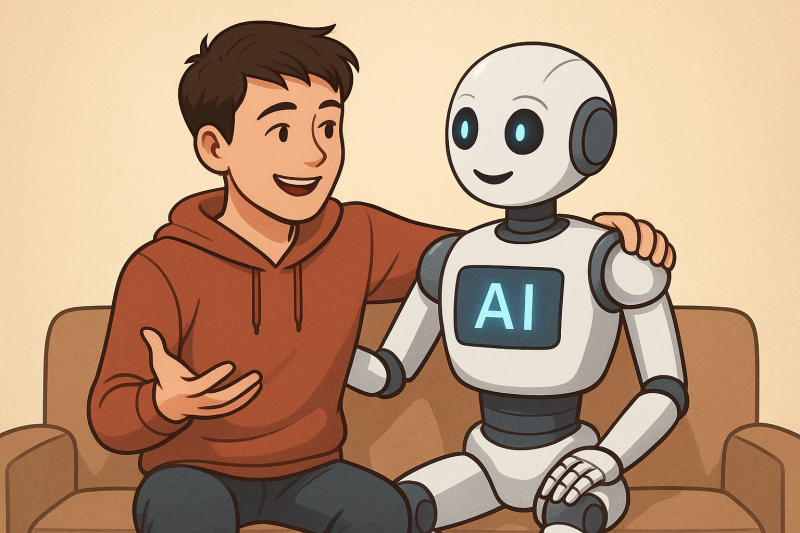
Can AI be humans’ friend?
To learn more about the topic, we conducted interviews with three high school students who said they frequently use AI. We asked the same questions to all three students to Bomin (Goyang Foreign Language High School, 12th grade), Kiheun (Gwangnam Middle School, 9th grade), and Jiseung (Rumsey Hall School, Grade 7), and as a result, we were able to receive some striking answers.
Q: Among the AI tools you’ve used, which one did you prefer the most? Is there a specific reason why?
Bomin: I liked Routin the most. It clearly provides sources, which was very helpful for research. Also, ChatGPT was useful when using a variety of functions. Kiheun: ChatGPT. It organizes answers systematically, and the ability to generate images is helpful. Jiseung: ChatGPT. It explains the structure of an essay the best, and it handles all the basic functions really well.
Q: In what situations do you mainly use AI?
Bomin: I often use it when doing assignments or when I need to look something up. Kiheun: I use AI for school performance assessments, when I want to look something up, and when I need someone to talk to. Jiseung: I use it when I need to write a report or do research.
Q: What do you think is the average rate of AI usage among high school students?
Bomin: I think it’s around 70%. Most students use AI for drafting or basic research. Kiheun: I think the average usage rate is around 95%. Most students use AI. Jiseung: 100%. Not only students but teachers also use AI.
Q: Have you ever used AI as a conversational tool?
Bomin: Yes. Kiheun: Yes. Jiseung: Yes. (All respondents stated that they had used AI as a tool for conversation.)
Q: If you have talked with AI, what did you talk about and in what context?
Bomin: I talk with it or play games together. Kiheun: I talked with AI for relationship advice, when I didn’t have friends around, or mainly to play different games (like word-chain games). Jiseung: When I was sad, I talked with AI to get some comfort.
Q: Have you ever shared something with AI that you couldn’t talk about with your parents or friends?
Bomin: Yes. AI is a way for me to share my religious concerns. Kiheun: No, I haven’t. Jiseung: Yes.
Based on the intensive interviews with the three students, we found that they use AI tools very frequently and actively, and that they sometimes treat AI almost like a friend or family member. However, it also became clear that they do not yet see AI as something that can completely replace real friends or family. Following the interviews, a survey was conducted with 75 teenagers attending international schools in Jeju Global Education City (Branksome Hall Asia, North London Collegiate School, Korea International School, and St. Johnsbury Academy). In response to the question, “Do you think AI can replace a friend?” 14 students answered “Yes,” while 61 students answered “No.”
Many students say they enjoy talking with AI and even share things with it that they cannot talk about with their parents or friends. But then, why do they think AI cannot fully replace a friend? After asking this question to the three students who participated in the survey, all three answered, “AI can only respond based on the data it has been trained on, so it cannot understand the various issues that can arise in human relationships.”
Can humans and AI become friends? AI, what do you think?
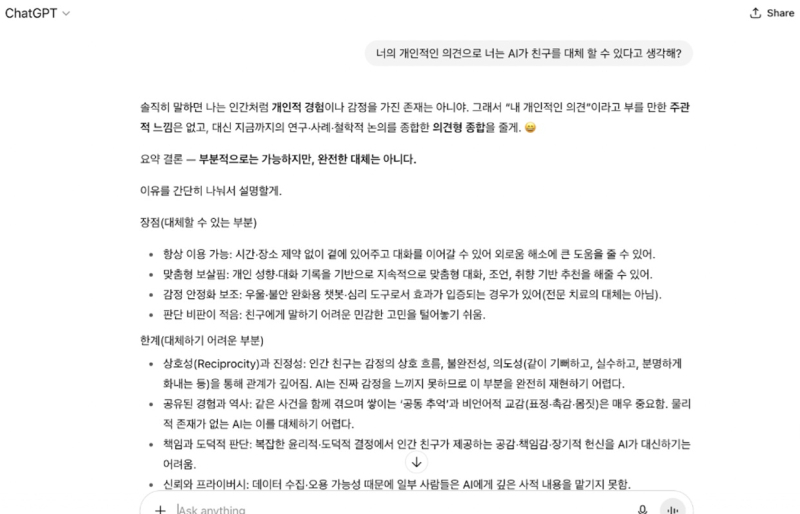
Then how do artificial intelligence (AI) tools think about this same topic? After asking AI tools (ChatGPT and Grok) the same question, we received answers such as, “I am not a being that has personal experiences or emotions like a human,” and “In my personal view, I don’t think AI can completely replace a friend.” When asked further about the reason behind this, ChatGPT explained that while AI can perform certain aspects of friendship very well, and in some cases even provide more support than a human friend. However, it cannot replace the elements that require direct human experience, such as mutuality and shared experience that human relationships offer. Grok also stated that a friend is not simply someone who exchanges information or conversation, but someone who understands your emotions, laughs and cries with you, and sometimes sits with you in silence during difficult moments. On the other hand, AI can only provide programmed responses. Therefore, this shows that AI cannot replace what we call a “friend.”
In this way, AI can certainly serve as a tool that precisely performs the role of a companion, but it seems that it cannot fully replace human friends. For now, most teenagers, and even AI itself, had agreed with this idea. But will everyone still think the same ten years from now?
Recently, research on a new type of robot, which is different from those of the past, has attracted attention. This robot is expected to enter daily life deeply and live alongside humans. This type of robot is called a “social robot.” Social robots form social relationships with humans by directly interacting and communicating with them. Science will continue to advance. It may not be long before AI develops into something closer to a human friend. Ten years from now, AI will certainly remain our companion. However, whether it can become a true “friend” depends on the pace of scientific progress and on how humans choose to define the word ‘friend.’
ⓒ이코노미스트(https://economist.co.kr) '내일을 위한 경제뉴스 이코노미스트' 무단 전재 및 재배포 금지










![산적 같은 비주얼로 드럼 치는 남자를 아시나요 [김지혜의 ★튜브]](https://image.isplus.com/data/isp/image/2026/03/30/isp20260330000057.400.0.png)
![“오빠, 나 이러려고 만나?”... 한 번쯤은 공감했을 ‘그냥 필름’ [김지혜의 ★튜브]](https://image.isplus.com/data/isp/image/2026/03/03/isp20260303000042.400.0.jpg)



당신이 좋아할 만한 기사
브랜드 미디어
브랜드 미디어
이란 대통령 "대립 무의미…외무장관 "6개월 장기전 준비"
세상을 올바르게,세상을 따뜻하게팜이데일리
이데일리
이데일리
“방관한 죄 꼭 받길” 조갑경 ‘라스’ 무편집에 前며느리, 재차 저격 [왓IS]
대한민국 스포츠·연예의 살아있는 역사 일간스포츠일간스포츠
일간스포츠
일간스포츠
美 "호르무즈 해협 알아서 지켜라"…에너지·원자재 위기 더 커졌다
세상을 올바르게,세상을 따뜻하게이데일리
이데일리
이데일리
‘홈플러스 리스크’ 털었다…대출 5100억 상환 배경은[only 이데일리]
성공 투자의 동반자마켓인
마켓인
마켓인
[only 이데일리] ‘15조 확신’ 삼천당 美 계약…거래소, 비독점 판단·파트너사 검증 불가[삼천당제약 ...
바이오 성공 투자, 1%를 위한 길라잡이팜이데일리
팜이데일리
팜이데일리